
Appearance
Alerts
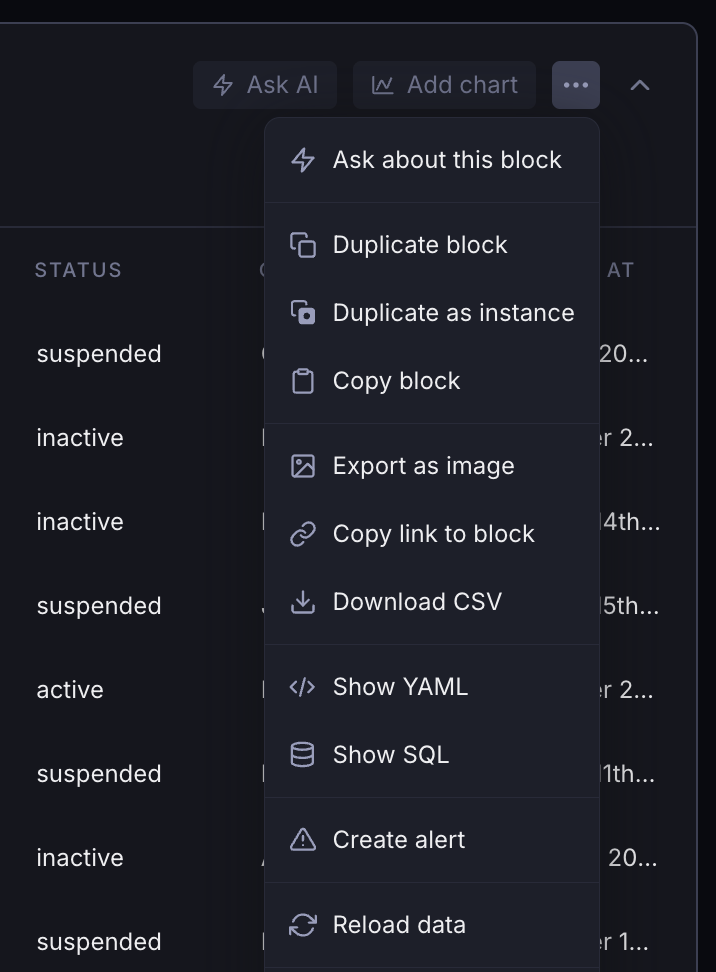
Supersimple lets you set up alerts to get notified whenever new rows matching a certain criteria get added to your database.
Setup
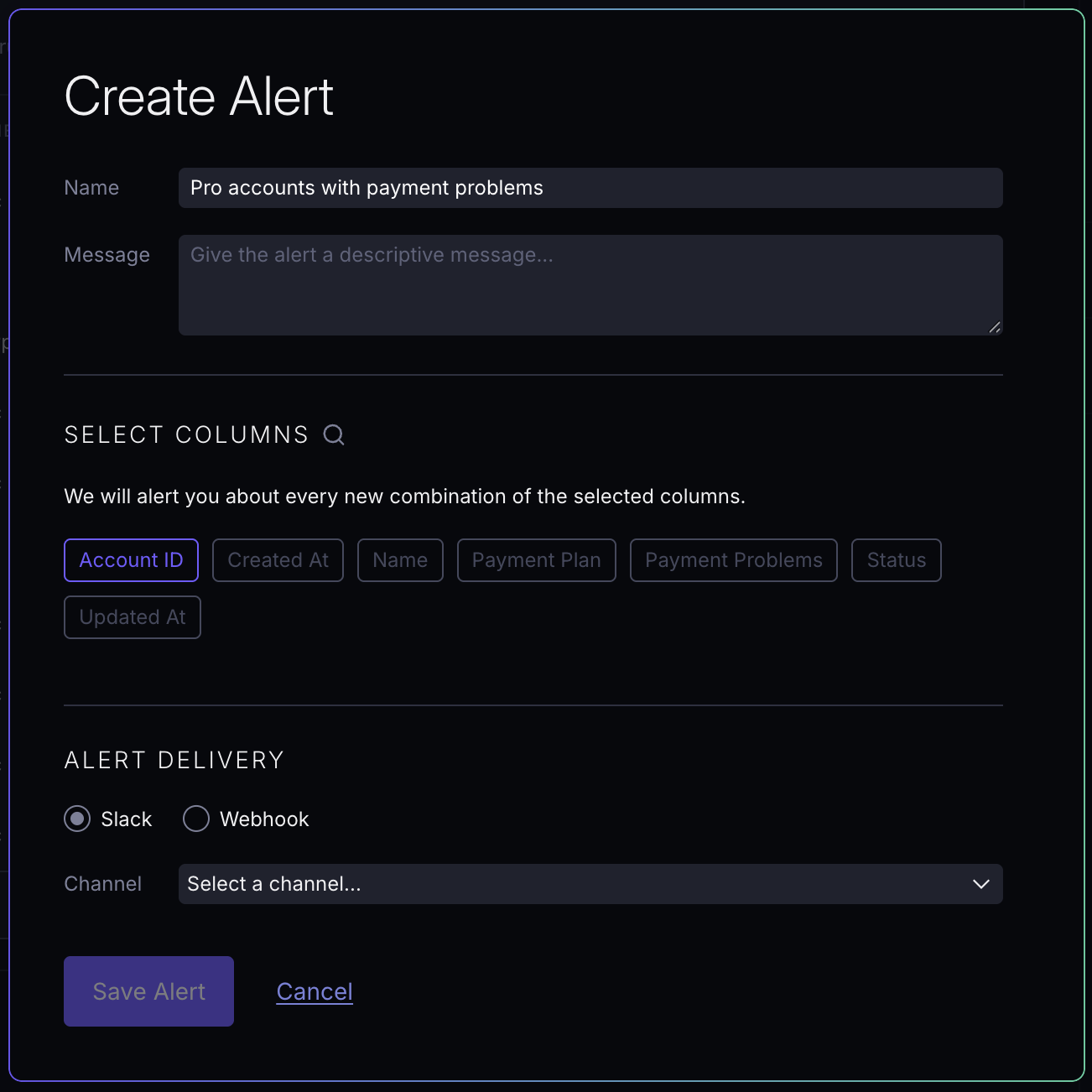
When setting up an alert, you'll be asked to choose which columns to use for determining alert uniqueness. To illustrate how this works, let's look at a couple of examples:
- Using "Account ID": notify any time an account ID shows up in this list that hasn't previously been alerted about
- Using "Account ID" + "Status": notify any time an account's status changes to a status that it hasn't had before
- Using "Account ID" + a custom formula column of
start_of_month(now()): notify at most once per month for each account
Note that, while the uniuqueness of a row is determined by the columns you select, the alert message/payload will include all the visible columns in the table.
Alert delivery
Alerts can be sent to either Slack or custom webhooks.
Slack
If your account has an active Slack integration, you can select a Slack channel as the alert destination. Each matching alert row will then be sent as a separate Slack message.
Slack can be connected under the Integrations tab of account settings by account admins.
Webhooks
Using custom webhooks, we send over the row as a JSON POST payload.
Existing alert rows
Any rows that are seen in the results of the alert query at the time of creating the alert are ignored and set as "already seen".
Any relevant changes to that table from that moment onwards will deliver alerts.
Scheduled (recurring) reports
To send charts on a schedule, scheduled exports are the simpler route: they deliver a whole exploration by email or Slack every day, week or month. Alerts suit reports that should arrive as rows of data instead.
You can use alerts to send scheduled reports by creating a time-based column that changes on a predictable schedule.
Alerts check for new values every 5 minutes. When the value in your selected column changes, the alert fires. This means if you create a column that changes at a specific time, your alert will be delivered at that time.
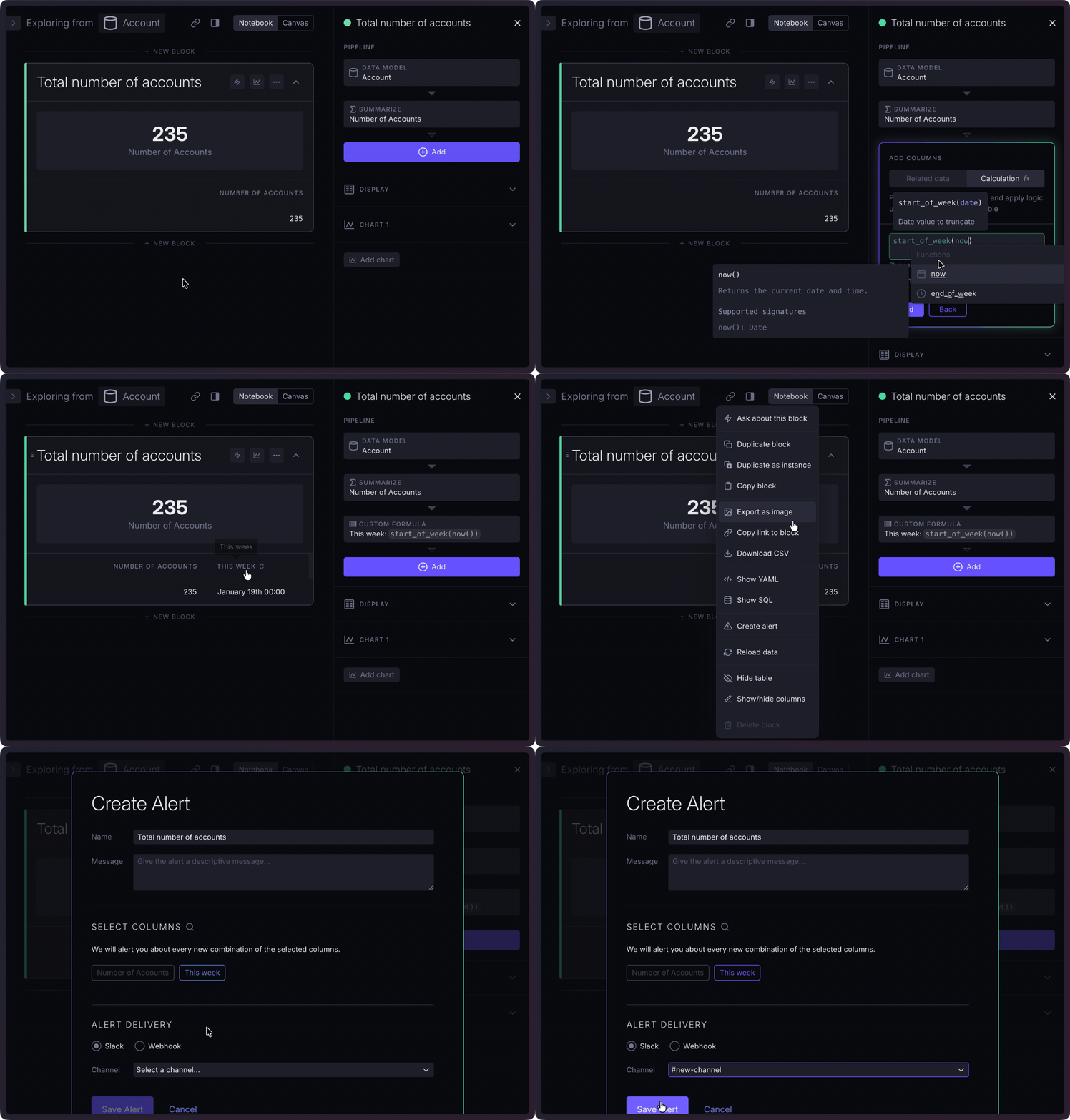
Example: Weekly report every Monday at 9am
- Let's assume we have a block with some aggregated stats as columns (e.g. Signups and New Revenue, filtered to the current week)
- Add a new column with the formula
week_number(now()) - Add a filter where
hour(now()) >= 9 - Set up an alert using the week number column for uniqueness
The week number changes at midnight, but the filter holds back the alert until 9am. Once 9am arrives, the filter passes and the alert fires.
More example schedule patterns
| Schedule | Uniqueness column | Filter |
|---|---|---|
| Daily at midnight (account time zone) | start_of_day(now()) | – |
| Monthly on the 1st weekday at 7am | start_of_month(now()) | hour(now()) >= 7 && day_of_week(now()) <= 5 |